Product Model: N3K-C3548P-10GX
Retail Price: US$12,031.00
Email Us To Get Special Price Today: [email protected]
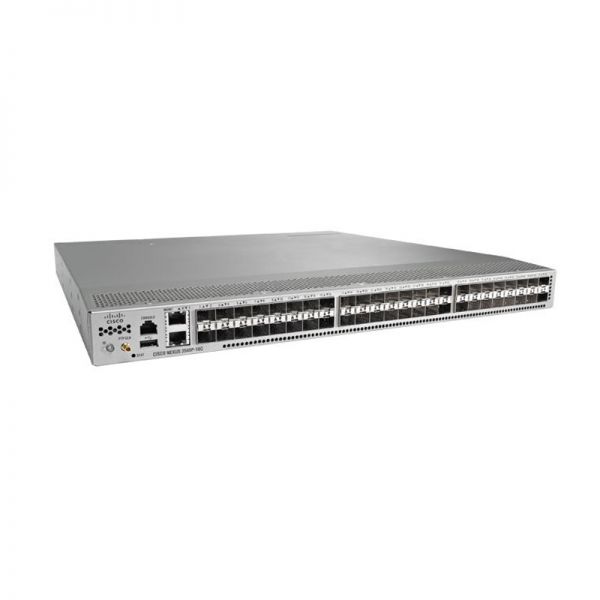
The Cisco Nexus 3548P-10GX (N3K-C3548P-10GX) is 1 rack unit (RU) switch with 48 fixed 1- and 10-Gigabit Ethernet small form-factor pluggable (SFP+) ports, 1 fixed 10/100/1000 management port, 1 console port, and 2 USB ports. This switch supports both port-side exhaust and port-side intake airflow schemes. It requires one AC or DC power supply for operations, but it can have a second power supply for redundancy.
Quick Specs
Table 1 shows the Quick Spec.
|
Product Code |
N3K-C3548P-10GX |
|
Enclosure Type |
1 RU |
|
Switching Capacity |
960-Gbps |
|
Forwarding Rate |
720 Mpps |
|
Configurable Maximum Transmission Units (MTUs) |
Up to 9216 bytes (jumbo frames) |
|
Ports |
48 x fixed SFP+ ports (1 or 10 Gbps) 1 x 1-PPS timing port, with the RF1.0/2.3 QuickConnect connector type 1 x 10/100/1000-Mbps management port 1 x RS-232 serial console port 2 x USB ports |
|
Number of power supplies |
2 |
|
Typical operating power |
112W |
|
Dimensions (H x W x D) |
4.36 x 43.9 x 46.7 cm |
|
Net Weight |
7.9 Kg |
Product Details
Figure 1 shows the front panel of the N3K-C3548P-10G for reference. It¡¯s similar with N3K-C3548P-10GX except that N3K-C3548P-10GX supports 2 USB ports and only 1 management port.
Note:
|
¢Ù |
Management, Console, and USB ports |
|
¢Ú |
48 x fixed small form-factor pluggable (SFP+) ports |
¡¤ The switch also offers dual redundant hot-swappable power supplies and four individual redundant hot-swappable fans on the back panel.
The Accessories
Table 2 shows recommended accessories.
|
Models |
Description |
|
N3548-ALGK9= |
Nexus 3500 Algo Boost License Spare |
|
N3548-LAN1K9= |
Nexus 3548 Layer 3 LAN Enterprise License Spare |
|
GLC-SX-MMD |
Cisco GLC-SX-MMD 1000BASE-SX SFP transceiver module, MMF, 850nm, DOM |
|
GLC-LH-SMD |
Cisco GLC-LH-SMD 1000BASE-LX/LH SFP transceiver module, MMF/SMF, 1310nm, DOM |
|
SFP-10G-SR |
10GBASE-SR SFP Module |
|
SFP-H10GB-CU1M |
Cisco Direct-Attach Twinax Copper Cable Assembly with SFP+ Connectors SFP-H10GB-CU1M |
|
SFP-H10GB-CU5M |
SFP-H10GB-CU5M,5M Passive Copper Twinax Cable F, Nexus,24AWG cable assembly |
Compare to Similar Items
Table 3 shows the comparison of similar items.
|
Product Code |
N3K-C3548P-10G |
N3K-C3548P-10GX |
|
Enclosure Type |
1 RU |
1 RU |
|
Switching Capacity |
960-Gbps |
960-Gbps |
|
Forwarding Rate |
720 Mpps |
720 Mpps |
|
Ports |
48 x fixed SFP+ ports (1 or 10 Gbps) 1 x 1-PPS timing port, with the RF1.0/2.3 QuickConnect connector type* 2 ¡Á 10/100/1000-Mbps management ports 1 x RS-232 serial console port 1 x USB port |
48 x fixed SFP+ ports (1 or 10 Gbps) 1 x 1-PPS timing port, with the RF1.0/2.3 QuickConnect connector type 1 x 10/100/1000-Mbps management port 1 x RS-232 serial console port 2 x USB ports |
Before Purchasing
Do you have anyquestion aboutthe N3K-C3548P-10GX
Contact us – Email Live Chat or [email protected].
N3K-C3548P-10GX Datasheet
N3K-C3548P-10GX Specification |
||||
|
Physical |
¡ñ 48 fixed SFP+ ports (1 or 10 Gbps) ¡ñ Dual redundant hot-swappable power supplies ¡ñ Four individual redundant hot-swappable fans ¡ñ One 1-PPS timing port, with the RF1.0/2.3 QuickConnect connector type* ¡ñ One 10/100/1000-Mbps management port ¡ñ One RS-232 serial console port ¡ñ Two USB ports ¡ñ Locator LED ¡ñ Locator LED button |
|||
|
Performance |
¡ñ 960-Gbps switching capacity ¡ñ Forwarding rate of 720 mpps ¡ñ Line-rate traffic throughput (both Layer 2 and 3) on all ports ¡ñ Configurable MTUs of up to 9216 bytes (jumbo frames) |
|||
|
Typical operating power |
¡ñ 112W |
|||
|
Maximum power |
¡ñ 213W |
|||
|
Typical heat dissipation |
¡ñ 383 BTUs per hr
|
|||
|
Maximum heat dissipation |
¡ñ 727 BTUs per hr |
|||
|
Hardware Specifications |
||||
|
|
Mode |
Normal Mode |
Warp Mode |
|
|
Hardware tables and scalability |
Number of MAC addresses |
64,000 |
8000 |
|
|
Number of IPv4 unicast routes |
24,000 |
4000 |
||
|
Number of IPv4 hosts |
64,000 |
8000 |
||
|
Number of IPv4 multicast routes |
8000 |
8000 |
||
|
Number of VLANS |
4096 |
|||
|
Number of ACL entries |
4096 |
|||
|
Number of spanning-tree instances |
Rapid Spanning Tree Protocol (RSTP): 512 Multiple Spanning Tree (MST) Protocol: 64 |
|||
|
Number of EtherChannels |
24 |
|||
|
Number of ports per EtherChannel |
24 |
|||
|
Buffer size |
6 MB shared among 16 ports; 18 MB total |
|||
|
Boot flash memory |
2 GB (3524P and 3548P models) 4 GB (3524X and 3548X models) |
|||
|
Power |
Number of power supplies |
2 (redundant) |
||
|
Power supply types |
¡ñ AC (forward and reversed airflow) ¡ñ DC (forward and reversed airflow) |
|||
|
Input voltage |
100 to 240 VAC |
|||
|
Frequency |
50 to 60 Hz |
|||
|
Power supply efficiency |
89 to 91% at 220V |
|||
|
Cooling |
Forward and reversed airflow schemes ¡ñ Forward airflow:Port-side exhaust (air enters through fan tray and power supplies and exits through ports) ¡ñ Reversed airflow: Port-side intake (air enters through ports and exits through fan tray and power supplies) Four individual, hot-swappable fans (3+1 redundant) |
|||
|
Environment |
Dimensions (height x width x depth) |
1.72 x 17.3 x 18.38 in. (4.36 x 43.9 x 46.7 cm) |
||
|
Weight |
17.4 lb (7.9 kg) |
|||
|
Operating temperature |
32 to 104° F (0 to 40°C) |
|||
|
Storage temperature |
-40 to 158° F (-40 to 70°C) |
|||
|
Relative humidity (operating) |
¡ñ 10 to 85% noncondensing ¡ñ Up to 5 days at maximum (85%) humidity ¡ñ Recommend ASHRAE data center environment |
|||
|
Relative humidity (nonoperating) |
5 to 95% noncondensing |
|||
|
Altitude |
0 to 10,000 ft (0 to 3000m) |
|||
|
Mean time between failure (MTBF) |
317,030 hours |
|||
|
Software Features |
||||
|
Layer 2 |
¡ñ Layer 2 switch ports and VLAN trunks ¡ñ IEEE 802.1Q VLAN encapsulation ¡ñ Support for up to 4096 VLANs ¡ñ Rapid Per-VLAN Spanning Tree Plus (PVRST+) (IEEE 802.1w compatible) ¡ñ MSTP (IEEE 802.1s): 64 instances ¡ñ Spanning Tree PortFast ¡ñ Spanning Tree Root Guard ¡ñ Spanning Tree Bridge Assurance ¡ñ Cisco EtherChannel technology (up to 24 ports per EtherChannel) ¡ñ LACP: IEEE 802.3ad, IEEE 802.1ax ¡ñ Advanced PortChannel hashing based on Layer 2, 3, and 4 information ¡ñ Jumbo frames on all ports (up to 9216 bytes) ¡ñ Storm control (multicast and broadcast) ¡ñ Link-level flow control (IEEE 802.3x) ¡ñ vPC |
|||
|
Layer 3 |
¡ñ Layer 3 interfaces: Routed ports on interfaces, switch virtual interfaces (SVIs), PortChannels, and subinterfaces (total: 1024) ¡ñ 24-way Equal-Cost Multipath (ECMP) ¡ñ 4096 ACL entries ¡ñ Routing protocols: Static, RIPv2, EIGRP, OSPF, and BGP ¡ñ HSRP and VRRP ¡ñ ACL: Routed ACL with Layer 3 and 4 options to match ingress and egress ACLs ¡ñ VRF: VRF-Lite (IP VPN), VRF-aware unicast (BGP, OSPF, and RIP), and VRF?aware multicast ¡ñ VRF route leaking ¡ñ Jumbo frame support (up to 9216 bytes) |
|||
|
Multicast |
¡ñ Multicast: PIMv2, PIM Sparse Mode (PIM-SM), SSM, and BiDir ¡ñ Bootstrap router (BSR), Auto-RP, and Static RP ¡ñ MSDP and Anycast RP ¡ñ Internet Group Management Protocol (IGMP) Versions 2 and 3 |
|||
|
Security |
¡ñ Ingress ACLs (standard and extended) on Ethernet ¡ñ Standard and extended Layer 3 to 4 ACLs include IPv4, Internet Control Message Protocol (ICMP), TCP, and User Datagram Protocol (UDP) ¡ñ VLAN-based ACLs (VACLs) ¡ñ Port-based ACLs (PACLs) ¡ñ Named ACLs ¡ñ ACLs on virtual terminals (VTYs) ¡ñ Dynamic Host Configuration Protocol (DHCP) relay ¡ñ Control Plane Policing (CoPP) |
|||
|
Cisco Nexus Data Broker
|
¡ñ Topology support for tap and SPAN aggregation ¡ñ Traffic load balancing to multiple monitoring tools ¡ñ Time stamping using PTP ¡ñ Packet truncation ¡ñ Traffic filtering based on Layer 1 through Layer 4 header information ¡ñ Traffic replication and forwarding to multiple monitoring tools ¡ñ Robust RBAC ¡ñ Northbound Representational State Transfer (REST) API for all programmability support |
|||
|
Management |
¡ñ Power On Auto Provisioning (POAP) ¡ñ Python scripting ¡ñ Switch management using 10/100/1000-Mbps management or console ports ¡ñ CLI-based console to provide detailed out-of-band management ¡ñ In-band switch management ¡ñ Locator and beacon LEDs ¡ñ Configuration rollback ¡ñ SSHv2 ¡ñ Telnet ¡ñ AAA ¡ñ AAA with RBAC ¡ñ RADIUS ¡ñ TACACS+ ¡ñ Syslog ¡ñ Embedded packet analyzer ¡ñ SNMP v1, v2, and v3 ¡ñ Enhanced SNMP MIB support ¡ñ XML (NETCONF) support ¡ñ Remote monitoring (RMON) ¡ñ Advanced Encryption Standard (AES) for management traffic ¡ñ Unified username and passwords across CLI and SNMP ¡ñ Microsoft Challenge Handshake Authentication Protocol (MS-CHAP) ¡ñ Digital certificates for management between switch and RADIUS server ¡ñ Cisco Discovery Protocol Versions 1 and 2 ¡ñ RBAC ¡ñ SPAN on physical, PortChannel, and VLAN ¡ñ ERSPAN Versions 2 and 3 ¡ñ Ingress and egress packet counters per interface ¡ñ Network Time Protocol (NTP) ¡ñ Cisco OHMS ¡ñ Comprehensive bootup diagnostic tests ¡ñ Cisco Call Home ¡ñ Cisco DCNM ¡ñ Active buffer monitoring ¡ñ PTP (IEEE 1588) boundary clock |
|||
|
Management and Standards Support |
||||
|
MIB support |
Generic MIBs ¡ñ SNMPv2-SMI ¡ñ CISCO-SMI ¡ñ SNMPv2-TM ¡ñ SNMPv2-TC ¡ñ IANA-ADDRESS-FAMILY-NUMBERS-MIB ¡ñ IANAifType-MIB ¡ñ IANAiprouteprotocol-MIB ¡ñ HCNUM-TC ¡ñ CISCO-TC ¡ñ SNMPv2-MIB ¡ñ SNMP-COMMUNITY-MIB ¡ñ SNMP-FRAMEWORK-MIB ¡ñ SNMP-NOTIFICATION-MIB ¡ñ SNMP-TARGET-MIB ¡ñ SNMP-USER-BASED-SM-MIB ¡ñ SNMP-VIEW-BASED-ACM-MIB ¡ñ CISCO-SNMP-VACM-EXT-MIB Ethernet MIBs ¡ñ CISCO-VLAN-MEMBERSHIP-MIB Configuration MIBs ¡ñ ENTITY-MIB ¡ñ IF-MIB ¡ñ CISCO-ENTITY-EXT-MIB ¡ñ CISCO-ENTITY-FRU-CONTROL-MIB ¡ñ CISCO-ENTITY-SENSOR-MIB ¡ñ CISCO-SYSTEM-MIB ¡ñ CISCO-SYSTEM-EXT-MIB ¡ñ CISCO-IP-IF-MIB ¡ñ CISCO-IF-EXTENSION-MIB ¡ñ CISCO-NTP-MIB ¡ñ CISCO-IMAGE-MIB ¡ñ CISCO-IMAGE-UPGRADE-MIB |
Monitoring MIBs ¡ñ NOTIFICATION-LOG-MIB ¡ñ CISCO-SYSLOG-EXT-MIB ¡ñ CISCO-PROCESS-MIB ¡ñ RMON-MIB ¡ñ CISCO-RMON-CONFIG-MIB ¡ñ CISCO-HC-ALARM-MIB Security MIBs ¡ñ CISCO-AAA-SERVER-MIB ¡ñ CISCO-AAA-SERVER-EXT-MIB ¡ñ CISCO-COMMON-ROLES-MIB ¡ñ CISCO-COMMON-MGMT-MIB ¡ñ CISCO-SECURE-SHELL-MIB Miscellaneous MIBs ¡ñ CISCO-LICENSE-MGR-MIB ¡ñ CISCO-FEATURE-CONTROL-MIB ¡ñ CISCO-CDP-MIB ¡ñ CISCO-RF-MIB Layer 3 and Routing MIBs ¡ñ UDP-MIB ¡ñ TCP-MIB ¡ñ OSPF-MIB ¡ñ OSPF-TRAP-MIB ¡ñ BGP4-MIB ¡ñ CISCO-HSRP-MIB ¡ñ PIM-MIB |
||
|
Standards |
¡ñ IEEE 802.1D: Spanning Tree Protocol ¡ñ IEEE 802.1p: CoS Prioritization ¡ñ IEEE 802.1Q: VLAN Tagging ¡ñ IEEE 802.1s: Multiple VLAN Instances of Spanning Tree Protocol ¡ñ IEEE 802.1w: Rapid Reconfiguration of Spanning Tree Protocol ¡ñ IEEE 802.3z: Gigabit Ethernet ¡ñ IEEE 802.3ad: Link Aggregation Control Protocol (LACP) ¡ñ IEEE 802.1ax: Link Aggregation Control Protocol (LACP) ¡ñ IEEE 802.3ae: 10 Gigabit Ethernet ¡ñ IEEE 802.3ba: 40 Gigabit Ethernet ¡ñ IEEE 802.1ab: LLDP |
|||
|
RFC |
BGP ¡ñ RFC 1997: BGP CommunitiesAttribute ¡ñ RFC 2385: Protection of BGP Sessions with the TCP MD5 Signature Option ¡ñ RFC 2439: BGP Route Flap Damping ¡ñ RFC 2519: A Framework for Inter-Domain Route Aggregation ¡ñ RFC 2545: Use of BGPv4 Multiprotocol Extensions ¡ñ RFC 2858: Multiprotocol Extensions for BGPv4 ¡ñ RFC 3065: Autonomous System Confederations for BGP ¡ñ RFC 3392: Capabilities Advertisement with BGPv4 ¡ñ RFC 4271: BGPv4 ¡ñ RFC 4273: BGPv4 MIB: Definitions of Managed Objects for BGPv4 ¡ñ RFC 4456: BGP Route Reflection ¡ñ RFC 4486: Subcodes for BGP Cease Notification Message ¡ñ RFC 4724: Graceful Restart Mechanism for BGP ¡ñ RFC 4893: BGP Support for Four-Octet AS Number Space OSPF ¡ñ RFC 2328: OSPFVersion 2 ¡ñ 8431RFC 3101: OSPF Not-So-Stubby-Area (NSSA) Option ¡ñ RFC 3137: OSPF Stub Router Advertisement ¡ñ RFC 3509: Alternative Implementations of OSPF Area Border Routers ¡ñ RFC 3623: Graceful OSPF Restart ¡ñ RFC 4750: OSPF Version 2 MIB RIP ¡ñ RFC1724: RIPv2 MIB Extension ¡ñ RFC 2082: RIPv2 MD5 Authentication ¡ñ RFC 2453: RIP Version 2 ¡ñ IP Services ¡ñ RFC 768: User Datagram Protocol (UDP) ¡ñ RFC 783: Trivial File Transfer Protocol (TFTP) ¡ñ RFC 791: IP ¡ñ RFC 792: Internet Control Message Protocol (ICMP) ¡ñ RFC 793: TCP ¡ñ RFC 826: ARP ¡ñ RFC 854: Telnet ¡ñ RFC 959: FTP ¡ñ RFC 1027: Proxy ARP ¡ñ RFC 1305: Network Time Protocol (NTP) Version 3 ¡ñ RFC 1519: Classless Interdomain Routing (CIDR) ¡ñ RFC 1542: BootP Relay ¡ñ RFC 1591: Domain Name System (DNS) Client ¡ñ RFC 1812: IPv4 Routers ¡ñ RFC 2131: DHCP Helper ¡ñ RFC 2338: VRRP IP Multicast ¡ñ RFC 2236: InternetGroup Management Protocol, version 2 ¡ñ RFC 3376: Internet Group Management Protocol, Version 3 ¡ñ RFC 3446: Anycast Rendezvous Point Mechanism Using PIM and MSDP ¡ñ RFC 3569: An Overview of SSM ¡ñ RFC 3618: Multicast Source Discovery Protocol (MSDP) ¡ñ RFC 4601: Protocol Independent Multicast – Sparse Mode (PIM-SM): Protocol Datasheet (Revised) ¡ñ RFC 4607: Source-Specific Multicast for IP ¡ñ RFC 4610: Anycast-RP using PIM ¡ñ RFC 5015: PIM BiDir ¡ñ RFC 5132: IP Multicast MIB |
|||